Why I Believe $HYPE Price Will At Least Triple By Year-End
In the crypto space, projects with real revenue, strong cash flow, and a closed token value loop remain scarce. Hyperliquid is one of the very few projects currently delivering on these traits. Next, I will start from these aspects and explain from the perspective of the leverage effect of market share on valuation why I believe the $HYPE price will at least triple by the end of the year.
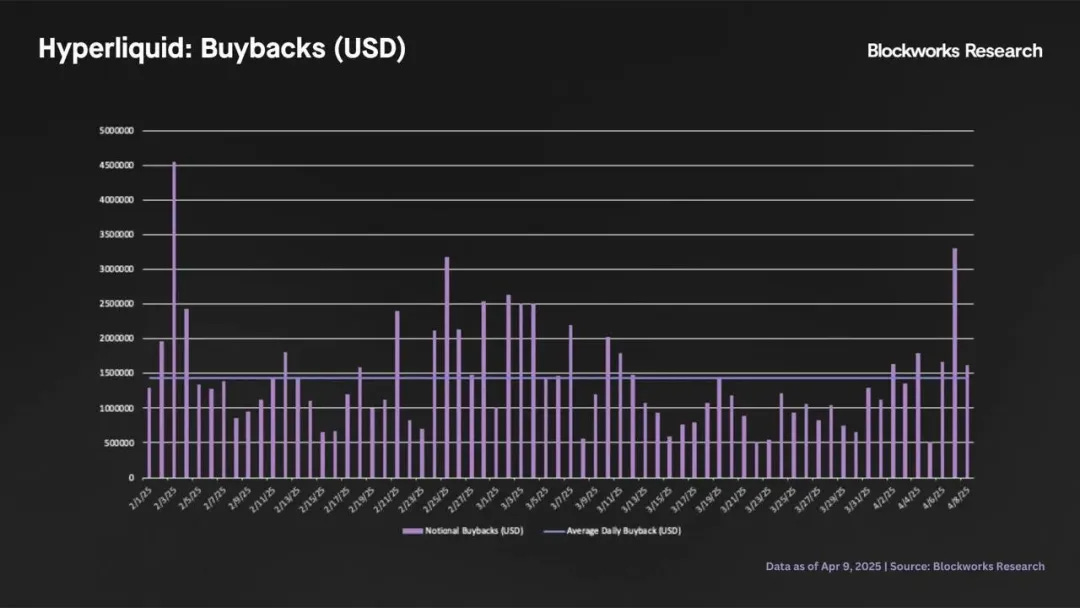
Buyback Narrative
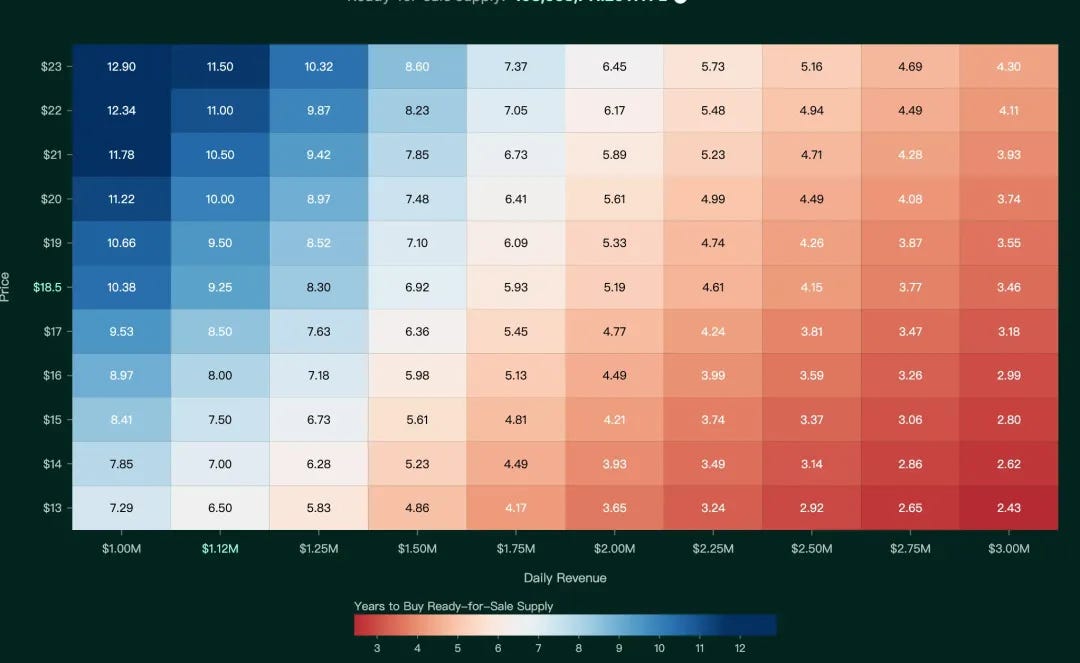
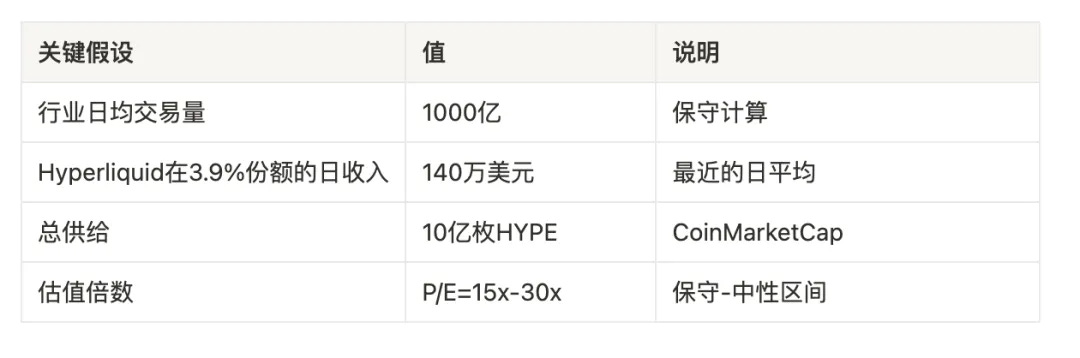
Platform revenue is mostly used to buy back $HYPE. Currently, 97% of Hyperliquid's revenue is used to buy back $HYPE. Since February, it has cumulatively bought back $96 million worth of HYPE tokens, equivalent to a daily buyback volume of about $1.4 million. Under the current market cap, all circulating tokens would theoretically be systematically bought back in less than 7 years. In essence, $HYPE holders indirectly own Hyperliquid's cash flow rights. HYPE is no longer just a tool for platform governance or incentives, but has become a value carrier strongly bound to platform revenue.
Revenue Flywheel (Exchange + L1 + Stablecoin)
Hyperliquid is simultaneously occupying the three most cash-flow-generating tracks in the Crypto ecosystem: derivatives exchange, Layer 1 blockchain, and stablecoin issuance. Currently, almost all revenue comes from the derivatives trading platform. With advantages such as stronger liquidity, lower fees, and no KYC, on-chain exchanges are gradually eating into the market share of CEXs. Moreover, Hyperliquid is constantly expanding spot trading pairs and is expected to support tokenized stocks, forex, commodities, and other new assets, opening up a larger market space. In the L1 space, HyperEVM is building the "AWS of on-chain finance", providing infrastructure for third-party teams. In the future, Hyperliquid is very likely to launch a native stablecoin, completing the final piece of the revenue flywheel.
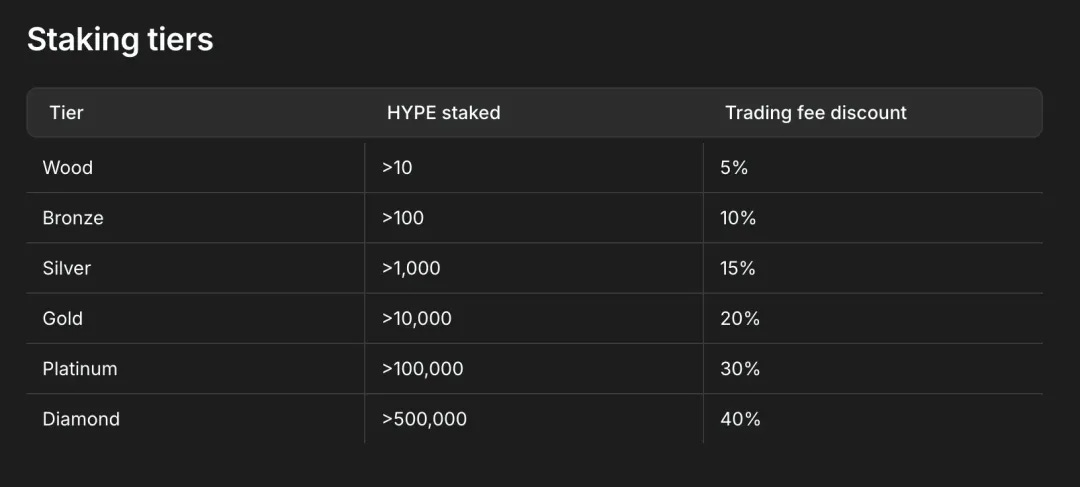
Staking Incentives
Continuous buying demand — to get discounts, users need to buy and stake $HYPE on the market. Users who hold and stake $HYPE will enjoy trading fee discounts. Strongly bound user relationships — staking means recognition and long-term holding. This mechanism will endow $HYPE with clear utility value for the first time, making it not just a passive beneficiary, but an "admission ticket" to actively participate in the ecosystem and reduce costs.
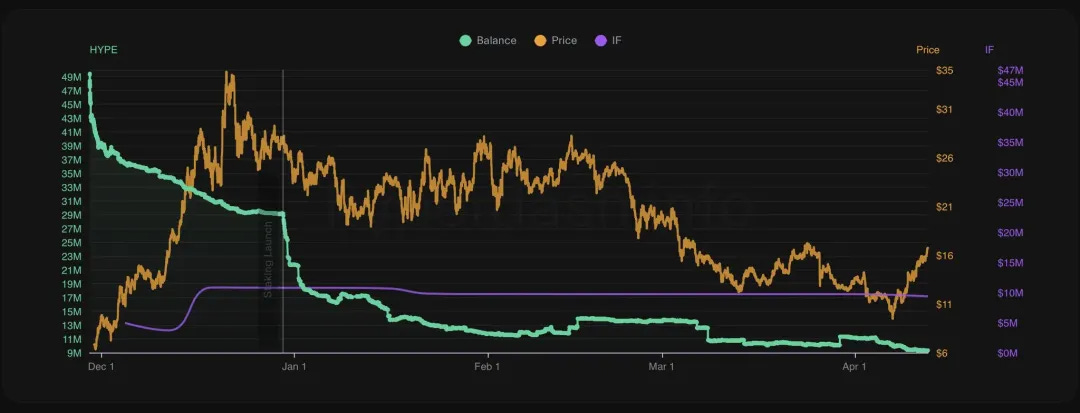
Airdrop Effect Exhausted, Market Enters Value Discovery Phase
Over 99% of HYPE airdrop addresses have completed liquidation, with selling pressure concentrated in the first 6 weeks after launch. Airdrop balances have plummeted from 49 million to less than 5 million, marking the complete washout of early profit-takers. As zero-cost chips exit, pricing power returns to real buying demand. HYPE is moving from the "airdrop speculation" phase into the "value reassessment" phase.
Risk Management
To prevent the recurrence of previous price manipulation attacks, Hyperliquid is systematically strengthening its risk management mechanisms, specifically including:
- Dynamic position limits: Flexible position caps for risk assets, especially newly listed tokens;
- Liquidation mechanism upgrade: No longer fully relying on HLP as the sole liquidation counterparty, introducing risk buffers, and publishing real-time HLP risk metrics;
- Community governance participation: Introducing a user voting mechanism to decide whether to delist certain tokens.
Market Share → Valuation
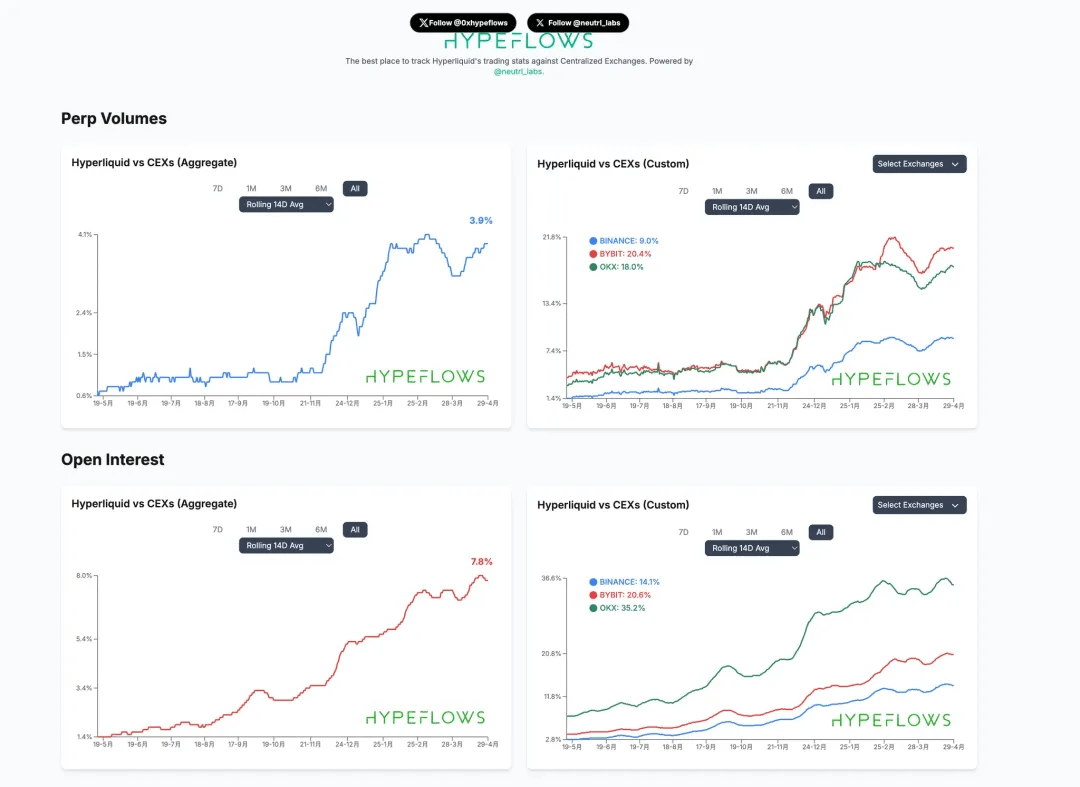
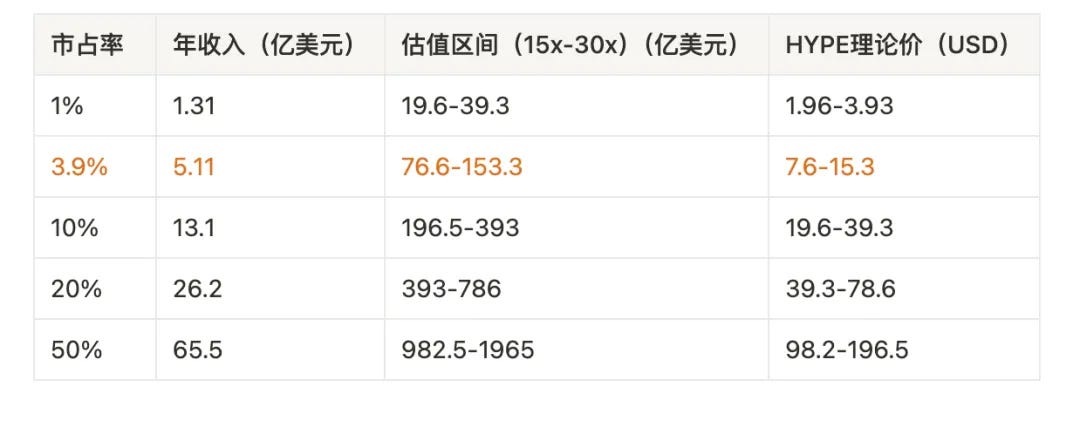
For every 1% upward shift in market share, HYPE's theoretical price should jump a level. Currently, Hyperliquid has firmly established itself as the leading on-chain exchange, but compared to other CEXs, its trading volume share is only 3.9%. At the current development speed, it will break 5% as soon as this quarter. Open interest growth is faster than trading volume: the OI share (7.8%) is twice the trading volume share, indicating that funds are not just coming in for matching, but continuing to stay on the platform to hold positions, reflecting an increase in both stickiness and deep liquidity.
Conclusion
It is worth noting that currently 97% of the revenue is used to buy back HYPE, and the actual circulating supply will decrease with buybacks. If supply shrinks while profits grow, the resulting leverage effect will be even stronger.
If Hyperliquid can achieve a market share of over 10% by year-end, the theoretical price of HYPE + bull market premium is enough to push the HYPE price above $40; if it can reach over 20%, breaking three digits is not impossible either.
As long as Hyperliquid's trading share + fund retention both maintain an upward slope, the valuation and token price will theoretically rise linearly or even super-linearly — this is also the core narrative the market is willing to pay a premium for.