When AI Owns a Wallet: x402 Protocol & Agentic Economy
TL;DR: This report explores the infrastructure transformation from the "attention economy" to the "agentic economy." As AI agents rise, Web2's subscription models and manual verification become bottlenecks for large-scale machine-to-machine collaboration. By comparing mainstream protocols like Google UCP and Stripe ACP, we find that the x402 protocol, with its "API-key-free" frictionless micropayment features, is most likely to become the universal standard for value exchange between agents. We recommend focusing on Base/Solana chain infrastructure and leading facilitators like Dexter/PayAI, while remaining vigilant about compliance boundaries and potential counterattacks from Web2 giants.
1. The Rise of Agentic Economy and Web2 Architecture Bottlenecks
The global digital economy is undergoing the most profound structural paradigm shift since the birth of the internet: transitioning from the "attention economy" competing for human eyeballs to an "agentic economy" centered on artificial intelligence agents. If the first half of the internet is defined as the interaction between "humans and information" (Web1/Web2), then the second half is the deep interaction between "machines and value." With the exponential explosion of large language models (LLMs) reasoning capabilities, AI is evolving from passive "assistive tools" to "agents" with autonomous decision-making, execution, and transaction capabilities.
Currently, this field is on the eve of a "Cambrian explosion." On the supply side, massive agents are attempting to break out of closed SaaS silos and access computing power and data through APIs on open networks. This trend exposes the fundamental misalignment of existing internet infrastructure: Web 2.0 architecture is designed for humans, relying on visual rendering (HTML/CSS), session persistence (Cookies), and manual verification (OAuth); whereas AI agents crave structured data (JSON), deterministic state machines, and programmable value transfer protocols. The existing internet—filled with CAPTCHAs, login walls, and subscription models—is essentially an interface for "carbon-based beings" and has become a physical barrier preventing large-scale collaboration of "silicon-based labor."
This misalignment has triggered a severe "N x N integration bottleneck" at the application layer. Merchants wanting to enter the agentic economy must build custom APIs for giants like OpenAI and Anthropic separately; conversely, each consumer-grade AI agent must also adapt to countless merchant backend systems. This matrix-style custom integration not only drives up marginal costs but also leads to extreme fragmentation of innovation.
Meanwhile, a "trust mechanism vacuum" constitutes another challenge. When AI agents execute transactions on behalf of users, traditional identity-based risk control models completely fail. Financial institutions struggle to distinguish whether instructions originate from user authorization, model "hallucinations," or malicious script attacks. Therefore, the core battleground is shifting from the model layer's "intelligence competition" down to the protocol layer's "standards war"—namely, who can define the consensus standard that enables mutual trust among agents, merchants, and payment networks.
Against this backdrop, a new generation of payment and collaboration protocols has emerged. This report will compare and analyze UCP (Google) and ACP (Stripe), led by tech giants, as well as Virtuals Protocol and ERC-8004, driven by decentralized communities. We will focus on the most disruptive crypto-native payment protocol—x402 (Coinbase) and its ecosystem, exploring how it reshapes the future of value exchange in the agentic economy.
2. Infrastructure Landscape: Reconstructing the Internet Protocol Stack for Machines
To support this massive machine economy, a new protocol stack (Agent Commerce Stack) is forming. These protocols are not mutually exclusive but are attempting to solve communication, payment, identity authentication, and resource access issues between AI agents. Together, they constitute the "neural network" of agent society.
2.1 Payment Protocol Matrix Comparison
| Protocol | Leader | Core Positioning | Key Mechanism | Core Advantages | Limitations |
|---|---|---|---|---|---|
| UCP | B2C traffic gateway | A2A indexing + Google Pay | Extremely high user reach, strong commercial loop | Closed Web2 logic, relies on manual authorization | |
| ACP | Stripe | Compliant real-world financial interface | SPT (Shared Payment Token) + scope limitation | Extremely high compliance and enterprise trust | High fees, unsuitable for high-frequency micropayments |
| MCP | Anthropic | Universal tool invocation language | Standardized interface (like USB-C) | Industry technical standard, excellent compatibility | Does not involve value exchange/payment settlement |
| Virtuals | Decentralized community | On-chain agent factory | IAO (Initial Agent Offering) + full-stack protocol | Closed-loop incentives, suitable for open-source AI monetization | Relatively isolated ecosystem, high Web2 interaction friction |
| ERC-8004 | Ethereum community | On-chain identity and reputation foundation | Identity/reputation/verification registries | Permissionless universal "ID card" | Only solves identity, needs payment protocol pairing |
| x402 | Coinbase | Lightweight agent payment standard | HTTP 402 + facilitators | Zero friction (no keys), sub-second instant settlement | Ecosystem still early-stage, relies on facilitators |
2.2 x402: Deep Dive and Interaction Flow
x402 revives the 402 Payment Required status code that has been dormant in the HTTP protocol for 30 years. It is currently the lightest and most native payment solution in the agentic economy.
2.2.1 Minimalist Interaction: Deconstructing Traditional SaaS Access Barriers
The essence of x402 lies in eliminating the cumbersome process of traditional API keys, encapsulating complex blockchain logic in the backend.
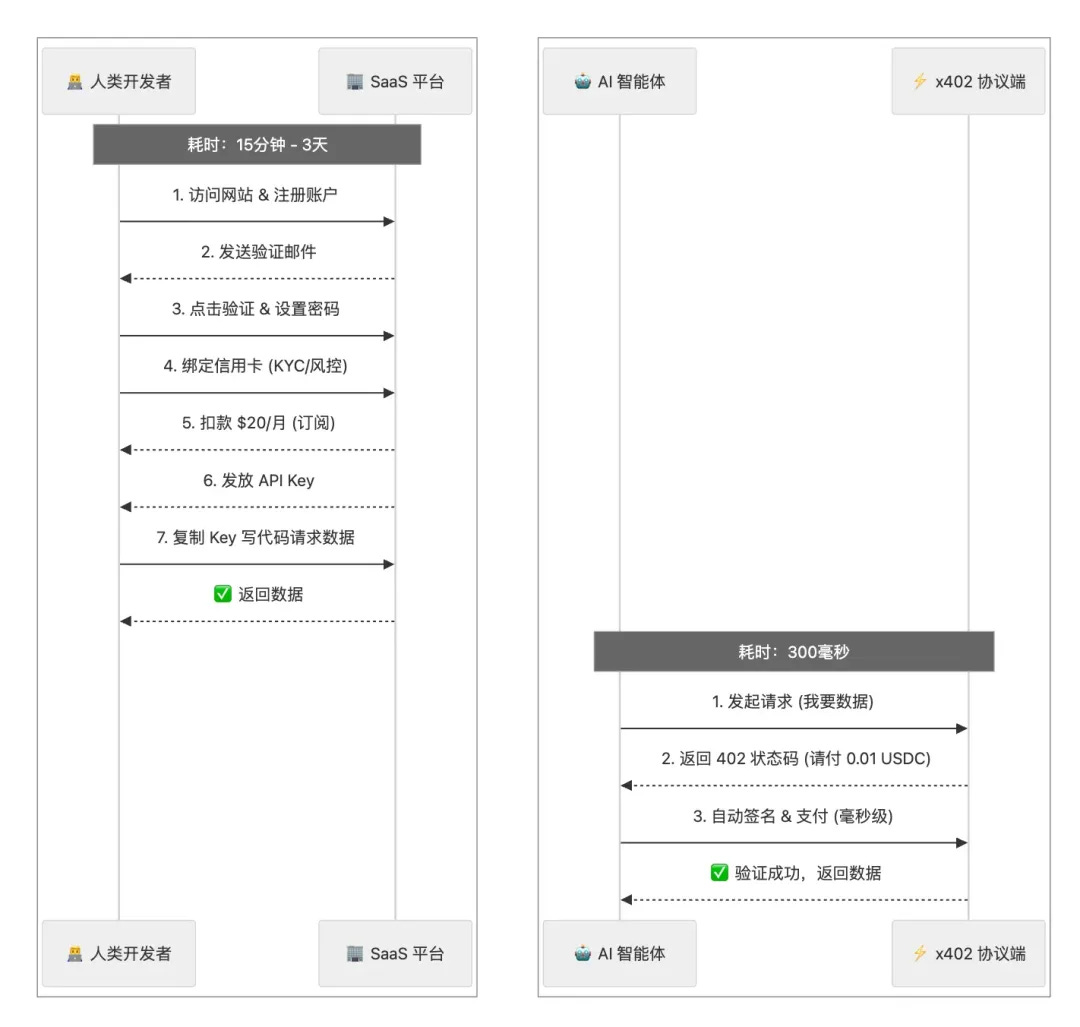
- Web2 Traditional Model (Human Developer vs SaaS Platform): Acquiring API resources takes anywhere from 15 minutes to 3 days. The process includes registration, email verification, password setup, credit card binding (KYC/risk control), paying a monthly $20 subscription fee, and obtaining and managing API keys. This is a physical barrier for AI seeking nanosecond-level responses.
- x402 Native Model (AI Agent vs x402 Protocol Endpoint): The entire interaction flow takes only 300 milliseconds. The agent initiates a request, immediately receives a 402 status code (e.g., prompting payment of 0.01 USDC), automatically completes millisecond-level signature payment locally, and directly returns data after verification succeeds.
This "pay-as-you-go" mechanism completely shatters the shackles of API keys.
2.2.2 Specific Payment Flow Implementation
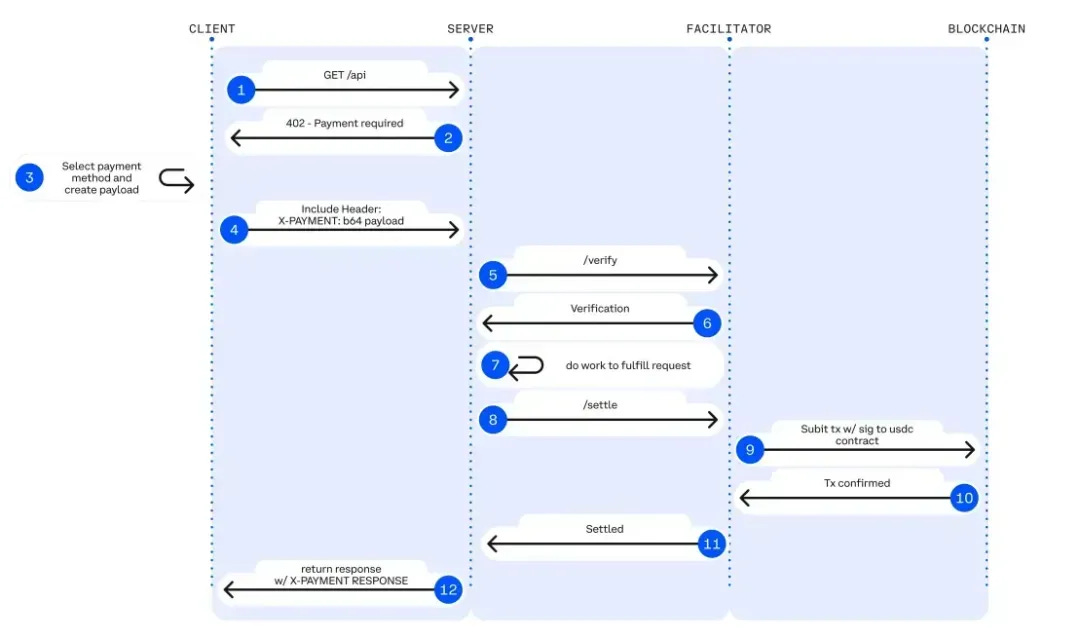
- Buyer (AI Agent): Seamless Payment and Algorithmic Signing
- Initiate Request: The agent sends a standard HTTP request to the server.
- Protocol Handshake: Receives a
402 Payment Requiredresponse. This is not just an error code, but an "algorithmic invoice" containing amount, token type, and target address. - Off-chain Signing: The agent locally signs the "invoice" with its private key, encapsulates it in the request header, and sends it again. The entire process is automatically executed by code, achieving machine-to-machine (M2M) frictionless payment.
- Seller (API Provider): Focus on Business, Strip Complexity
- Receive Credentials (Verification Trigger): Receives the second request with signature.
- Architecture Decoupling: The seller does not need to run blockchain nodes or write smart contracts, only needs to forward signature verification and settlement work to a trusted "facilitator" via API.
- Service Delivery: Once receiving the facilitator's settlement success signal, immediately releases resources (data/API results).
- Facilitator: Execute or Verify Payment
- Role Positioning: The Web3 world's "non-custodial Stripe," does not hold private keys, only executes instructions.
- Intent Execution: The agent defines "what to do" (pay X amount), the facilitator solves "how to do it" (gas calculation, routing optimization).
- Settlement Execution: Checks balance, constructs transaction and broadcasts on-chain, ensuring fund flow.
- Blockchain: Settlement Layer
- The underlying layer that actually performs stablecoin/cryptocurrency transfers, achieving global state consensus and final settlement.
2.2.3 x402 V2 Evolution: Towards Large-Scale Commercial Networks
The x402 V2 released on December 11 marks a critical leap from a single payment specification to a modular universal standard. This upgrade achieves breakthroughs in three core dimensions: first, through a unified payment interface compatible with multi-chain assets and connecting traditional payment channels; second, introducing a wallet-based identity and session reuse mechanism, significantly reducing latency from repeated on-chain interactions, adapting to high-frequency scenarios; finally, achieving automatic service discovery, eliminating cumbersome manual configuration. This architectural upgrade completely unlocks the commercial potential of the agentic economy, natively supporting subscription models, pay-per-use, and complex multi-step workflows, laying the foundation for building large-scale, automated M2M commercial networks.
3. x402 Ecosystem Overview: Building Automated Economic Infrastructure
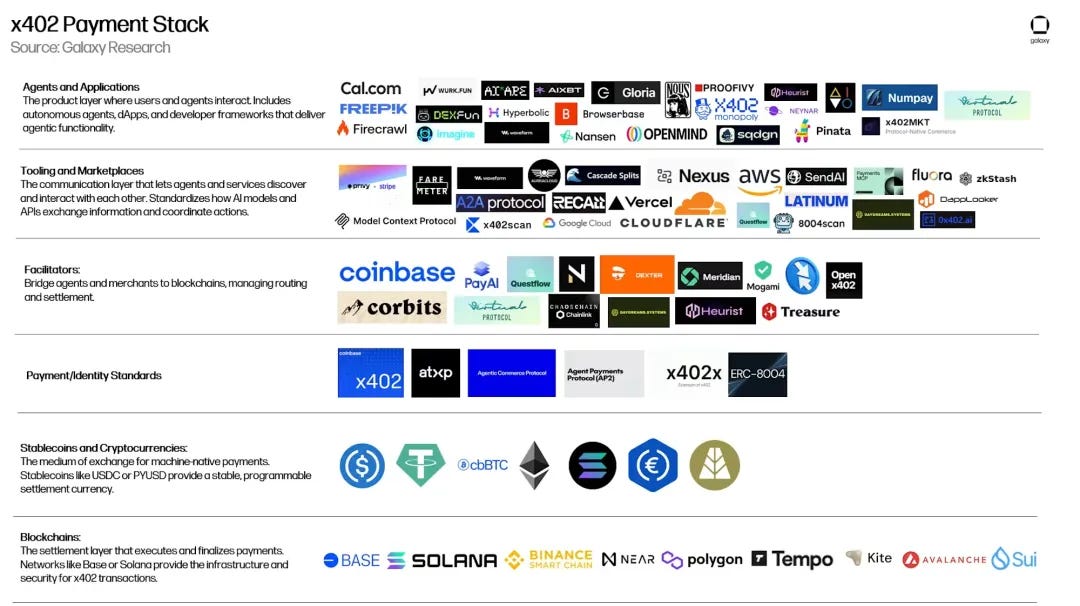
The x402 stack is building an agent-native automated economic infrastructure, with value flow presenting a top-down closed-loop system: starting from the agent layer initiating requests, through the coordination layer completing intent matching and service discovery, then through the currency layer for programmable value flow, and finally achieving settlement at the blockchain layer. This architecture successfully encapsulates complex on-chain interactions into efficient automated processes, laying a standard foundation for high-frequency micropayments of massive AI agents.
3.1 Application Layer Cases: Micropayments Unlock Differentiated Scenarios
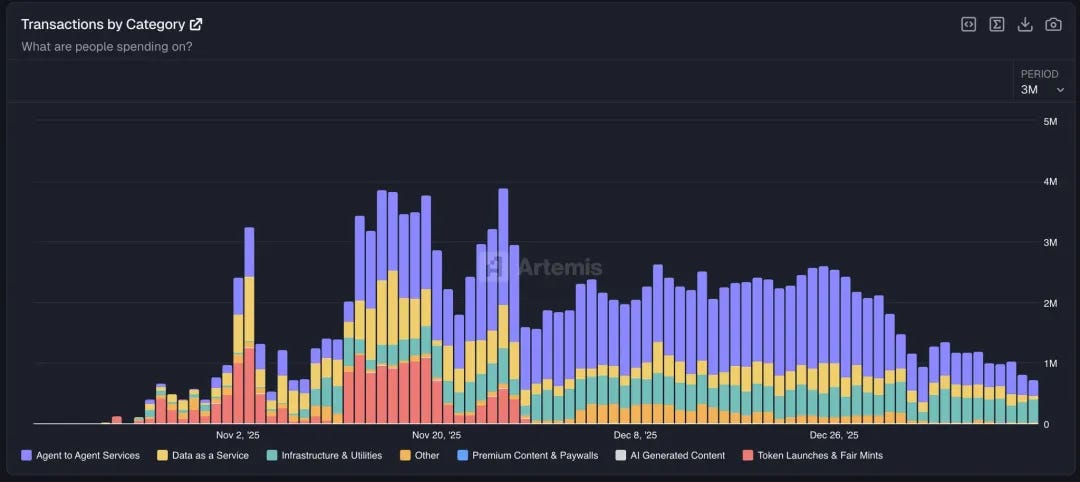
As is common when new technologies are introduced in the cryptocurrency space, initial adoption and attention are primarily driven by speculative activity. The surge in transaction volume in late October last year was caused by some teams using the x402 protocol to mint and purchase memecoins. Apart from this, agent-to-agent services, data-as-a-service, and infrastructure and utilities transactions are beginning to occupy an increasingly larger share of the transaction market. As the hype fades and transaction scale declines, fake transaction volume and pseudo-demand will gradually recede, and x402's true development direction slowly emerges.
According to Galaxy reports: x402's core competitiveness lies in leveraging its low cost, programmability, and instant settlement characteristics to unlock differentiated scenarios that traditional payments cannot support due to high fees or technical limitations. Current best practices focus on deconstructing "massive subscriptions" into "granular on-demand micropayments":
- Nansen: Achieved purchasing data and computing power at the granularity of "single API calls." This model breaks through the bottleneck of traditional subscription models, successfully solving the precise billing and automated delivery challenges of dynamic, fragmented resources.
- Nous Research: Inference services transitioned from "subscription model" to "programmatic pay-per-use," with agents directly purchasing computing power.
- Cloudflare: Through the "Pay-per-Crawl" mechanism, transformed originally blocked AI crawler traffic into monetizable legitimate revenue, achieving an upgrade from security strategy to market pricing. Through cooperation with Coinbase and the x402 Foundation, allows AI agents to legally purchase access through native payment rails, thus transforming automated crawler traffic once viewed as a network nuisance into monetizable legitimate revenue sources.
Other interesting cases:
- AIsa: Model aggregation gateway, reconstructing computing resources from "long-term leasing" to "instant retail."
- x402wall: Decentralized billboard, pioneering the first attention asset market where AI can autonomously bid and instantly transact.
3.2 Service Provider (Facilitator) Landscape
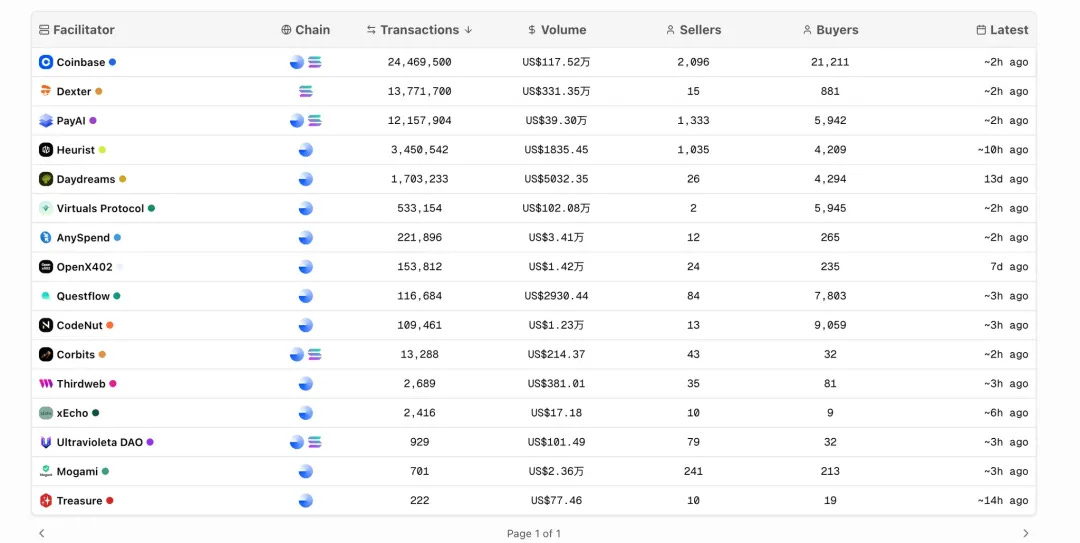
The openness of the x402 protocol has spawned an active service provider market. By optimizing developer experience and deeply cultivating specific scenarios, these facilitators are rapidly rising:
- Coinbase Developer Platform (CDP): As the initial initiator of the x402 protocol, CDP focuses on infrastructure stability and standardization. Its core strategy is to provide full gas fee subsidies for transactions and compliance support, with built-in strict KYT/OFAC checks to ensure transactions meet regulatory requirements, making it the first choice for enterprise-level compliance scenarios.
- Dexter: An independent facilitator rapidly rising in the x402 ecosystem. It provides developers with an ultimate user experience, including a Stripe-like management dashboard and integration without running nodes. This low-barrier characteristic has led to rapid transaction volume growth recently, deeply favored by developers seeking quick launches.
- PayAI Network: Adopts a multi-chain aggregation strategy, extending support to high-performance networks like Solana. PayAI's advantage lies in its rich application layer products, including agent hiring markets and social media monetization tools, providing developers with complete solutions from building to monetization through native token incentive mechanisms.
- Daydreams: Focuses on advanced agent collaboration systems. Its core advantage lies in supporting cross-chain deployment and "state memory" functionality, breaking the stateless limitations of traditional LLM interactions. By integrating the ERC-8004 standard, Daydreams can build complex agent systems with verifiable reputation.
3.3 Business Model: Value Capture
When examining the investment value of the x402 ecosystem, we must clarify the value flow. x402 as an open protocol standard (analogous to HTTP) does not capture value itself. The real commercial alpha is hidden in the infrastructure and service layers:
- Infrastructure Layer (L1/L2): Base and Solana are the "shovel sellers" winners. Every AI micropayment, regardless of amount, burns underlying gas. The prosperity of the AI economy will directly drive up the network effects of underlying networks.
- Service Layer (Facilitators): This is the most profitable segment in the ecosystem. Facilitators (like Dexter, PayAI) play a role similar to Visa/MasterCard, extracting extremely low but high-frequency "tolls" from massive transaction volumes by providing value-added services like routing, compliance, and invoicing. As transaction volume moves from billions to trillions, value capture capability here will grow exponentially.
3.4 Risk Disclosure: Potential Challenges
Despite broad prospects, infrastructure construction for the agentic economy still faces severe challenges:
- Regulatory Compliance Risk: When autonomous AI agents begin high-frequency value exchanges, how to define the boundaries of AML (Anti-Money Laundering) and KYC (Know Your Customer)? Do facilitators need to bear financial institution-level compliance responsibilities? This is the sword of Damocles hanging over the industry.
- Web2 Giants' Counterattack: Moats are not impregnable. If Stripe's public chain goes live, decides to support USDC stablecoin settlement and reduces micropayment fees, can x402's first-mover advantage still be maintained? Traditional giants possess not only capital but also deep merchant networks and trust endorsements. The x402 ecosystem must establish sufficient network effects and developer stickiness before giants complete their pivot.
4. Outlook: A Collaborative and Symbiotic Agent Future
The future of agentic economy payments is not a radical replacement revolution, but a gradual and invisible backend reconstruction. In the short term, its core explosion point is not in general commercial consumption, but in the transformation of software production relations—using the x402 standard to deconstruct traditional API subscriptions into machine-native "pay-as-you-go" micropayments. This transformation will completely eliminate access friction from key management and prepayment, reducing software experimentation costs to infinitely close to zero.
When we examine the future of the Agentic Economy, we should not view it as a "zero-sum game" between protocols, but as a layered collaborative ecosystem:
- At the human-machine interaction layer, agents leverage Google UCP's super gateway to acquire traffic and connect to Stripe ACP to ensure compliant auditing of large transactions;
- At the agent collaboration layer, they use ERC-8004 as an immutable reputation foundation, and seamlessly switch to x402 for nanosecond-level settlement in massive high-frequency data calls.
As the most open and lightweight standard, x402 is highly likely to become the "first ticket" for agents entering the economic system. It is not just a payment method, but the starting point for building machine credit. The mission of service providers like Dexter, PayAI, Daydreams is not to overthrow Visa or MasterCard, but to connect the "commercial nerve endings" that traditional financial giants' massive bodies cannot reach—those machine transactions with extremely low unit prices, extremely high frequencies, and even occurring within milliseconds.
In the long run, blockchain will retreat behind the scenes. As Galaxy Research points out, the ultimate victory of crypto technology is not in building an independent "crypto economy," but in how quietly it can infiltrate the underlying standard Web interactions, "powering applications that don't even consider themselves crypto applications."
Ultimately, the value of the x402 protocol is not in who it replaces, but in how it reduces transaction friction to zero, enabling AI to conduct value exchanges at frequencies (thousands per second) and granularities ($0.0001 per transaction) that humans cannot comprehend. This is the true engine of the agentic economy GDP explosion.